


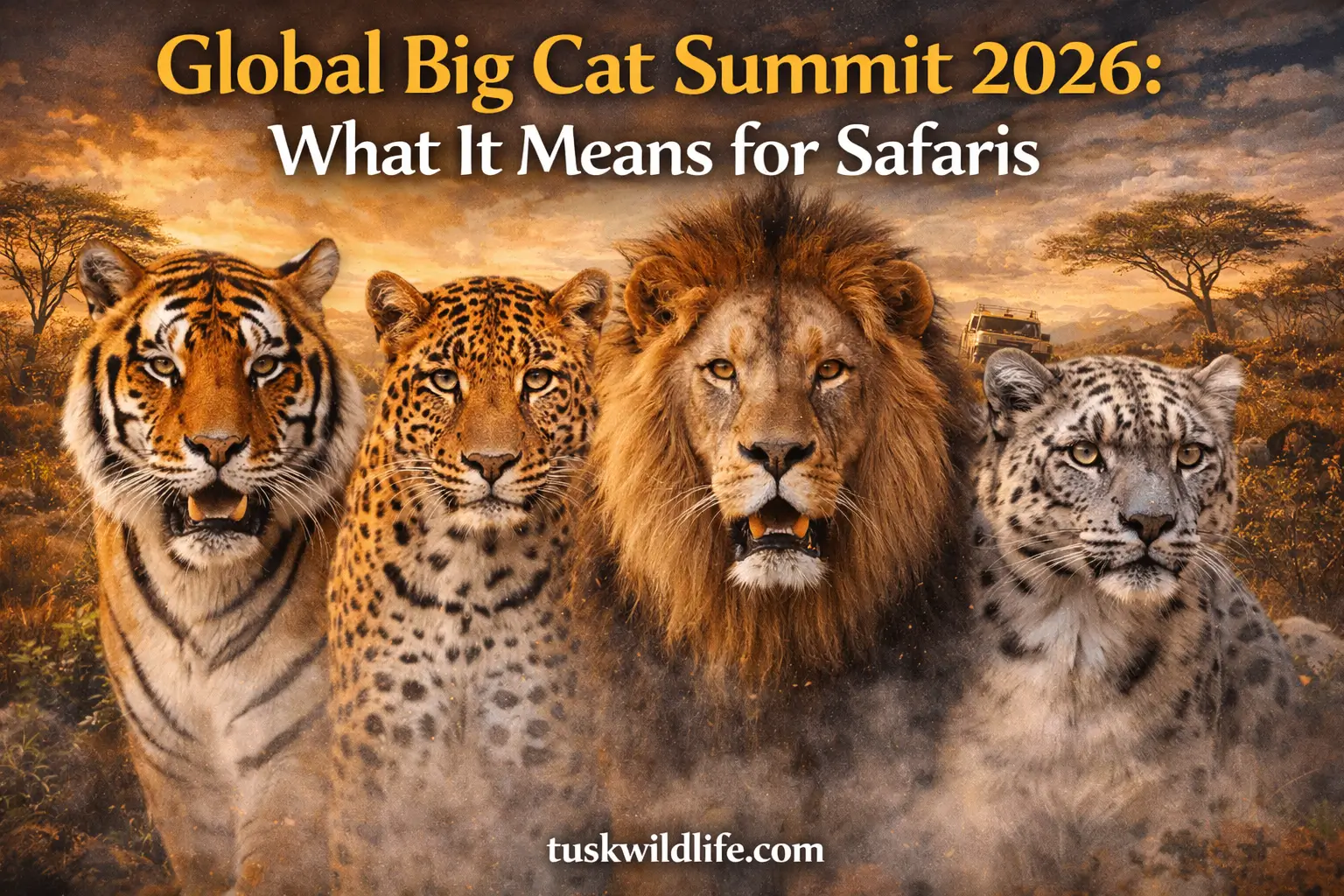
India has announced that it will host the first-ever Global Big Cat Summit in 2026. The announcement was made during the presentation of the Union Budget 2026 by Finance Minister Nirmala Sitharaman on 1 February 2026.
The summit will be hosted through the International Big Cat Alliance (IBCA) and is expected to bring together leaders, ministers, senior officials, and conservation experts from 95 big cat range countries to discuss collective strategies for protecting big cats and the ecosystems they support.
If you follow India’s wildlife scene closely (or plan tiger safaris), this isn’t just “conference news.” It signals stronger global attention on big-cat landscapes, more cross-border cooperation, and likely more focus on technology-led protection and responsible wildlife tourism standards in the years ahead.
Quick facts: What’s confirmed right now
- What: First-ever Global Big Cat Summit (also referred to as the International Big Cat Alliance Summit).
- Announced in: Union Budget 2026 presentation on 1 Feb 2026.
- Host: India, under the International Big Cat Alliance (IBCA).
- Who will participate: Heads of government, ministers, officials, and experts from 95 range countries.
- When: 2026 (exact dates are not officially confirmed in public updates yet).
- Related event: A separate international workshop/training programme on big cat conservation (MoEFCC + IBCA) is scheduled 9–13 Feb 2026 in the Bandipur–Nagarhole landscape (Karnataka), focusing on technology for protection.
What is the Global Big Cat Summit?
The Global Big Cat Summit is being positioned as a high-level international gathering where big cat range countries align on conservation priorities and cooperation. The central idea is straightforward: big cats don’t follow political borders, so long-term protection needs coordination across countries, not just within them.
Big cats are wide-ranging predators, and their survival depends on healthy landscapes. Protecting them typically strengthens entire ecosystems through:
- Protection of habitats and wildlife corridors
- Stronger anti-poaching systems and intelligence sharing
- Action against illegal wildlife trade networks
- Better management of human-wildlife conflict
- Climate resilience planning for forests, grasslands, and wetlands
A summit under a multi-country coalition like IBCA is meant to improve shared action, attract international support, and upgrade long-term conservation planning.
Who is organizing it: IBCA in simple terms
The summit is being hosted through the International Big Cat Alliance (IBCA), an India-led, multi-country initiative aimed at collaboration on big cat conservation. In simple terms, IBCA’s role is to bring countries onto a common platform for:
- Sharing proven conservation practices
- Improving training and field capacity
- Supporting technology and monitoring
- Strengthening cooperation on trade and enforcement issues
IBCA is often discussed in the context of India’s big conservation milestones such as Project Tiger and newer global collaborations around flagship species and habitat protection.
Who will attend: what “95 range countries” means
“Range countries” are countries where big cats naturally occur or have been reintroduced. The summit aims to include participation from 95 such countries—a wide geographic spread that covers different ecosystems and different challenges.
That matters because conservation solutions look very different across landscapes:
- Tiger landscapes in India and Southeast Asia face heavy pressure from habitat fragmentation and conflict near villages.
- Snow leopard landscapes involve high-altitude conditions, livestock predation conflict, and rugged monitoring challenges.
- Cheetah and lion landscapes often require large open habitats and strong corridor protection.
- Jaguar landscapes involve large forest systems and complex land-use pressures.
A summit that brings political leadership and experts together can help turn technical recommendations into policy priorities, funding, and coordinated action.
What the summit will focus on (expected themes)
Based on the way the summit has been framed publicly, the core focus is collective conservation strategy. For a wildlife audience, that typically means the following pillars:
1) Stronger protection and monitoring
- Better patrolling systems and modern enforcement
- Technology integration (camera traps, monitoring platforms, analytics, and rapid response)
- Training and capability building for frontline staff
2) Tackling illegal wildlife trade
- More coordinated intelligence sharing
- Improved investigation support and prosecution outcomes
- Cross-border coordination along trafficking routes
3) Habitat protection and connectivity
- Reducing fragmentation in forests, grasslands, and buffer areas
- Restoring corridors and improving landscape-level planning
- Strengthening climate resilience (water availability, heat stress, fire risk)
4) Human-wildlife conflict solutions
- Faster response mechanisms and early warning systems
- Community participation and local benefit models
- Conflict reduction strategies that work at village level
When and where will it happen?
The summit is scheduled for 2026. As of now, exact dates and the final venue have not been officially confirmed in widely available public detail. Some early mentions point to a possible timeline later in the year (for example, around April), but treat that as tentative until an official programme note is released.
What’s safe to communicate to readers today:
- Confirmed: 2026, India hosting, IBCA platform, 95 range countries.
- Awaiting confirmation: exact summit date(s), city/venue, detailed agenda.
We’ll update this post as soon as official details are published by the Ministry of Environment, Forest and Climate Change (MoEFCC) or IBCA.
Related February 2026 event: the Bandipur–Nagarhole training programme
Separately, an international workshop/training programme on big cat conservation (MoEFCC + IBCA) is scheduled for 9–13 February 2026 in the Bandipur–Nagarhole landscape (Karnataka). It is described as technology-focused, and it may act as a practical precursor to the larger summit.
Think of it this way: training programmes strengthen on-ground capacity, while a summit strengthens international alignment, policy attention, and long-term resourcing.
Why this summit matters to safari travelers
Most people hear “summit” and think it only affects diplomats. But big cat conservation influences the parks we visit in real ways. Here’s how it could matter for travelers over the next 12–24 months:
1) More global attention on big-cat landscapes
A global summit can increase attention on protected areas and surrounding landscapes—not only the famous parks but also lesser-known habitats that matter for connectivity and long-term survival.
2) More emphasis on technology-led protection
If monitoring and tech upgrades become a shared priority, that’s good for long-term stability in reserves. Better protection usually improves overall wildlife viewing conditions over time.
3) Stronger push for responsible tourism
When conservation becomes a bigger policy priority, enforcement of safari rules, guide training, and visitor conduct often become stricter. That’s good for wildlife welfare and for the quality of the safari experience.
If you’re planning your first safari, these guides will help:
- How to plan your first wildlife safari in India (step-by-step)
- First-time visitors guide to Indian national parks
What this means for India’s big-cat parks and safari circuits
The summit announcement fits how most travelers plan wildlife trips: pick a wildlife focus (tigers, lions, snow leopards, etc.) and then choose the right landscapes.
For tiger-focused trips
Explore trip options here:
Tiger safari tours in India.
For rhino + tiger landscapes in Assam
Planning Manas? These are useful:
For lions
For high-altitude big cats
How to keep track of official updates (without rumors)
Because dates and venue details can change, it’s best to rely on official announcements. Watch for updates from:
- MoEFCC (Ministry of Environment, Forest and Climate Change)
- International Big Cat Alliance (IBCA)
- Government budget documents and official briefings
We’ll update this post when the summit dates and venue are officially confirmed.
FAQs: Global Big Cat Summit 2026
1) What is the Global Big Cat Summit 2026?
It is a first-ever international summit announced by India in the Union Budget 2026, planned under the International Big Cat Alliance to strengthen global cooperation on big cat conservation.
2) Who is hosting the summit?
India is hosting the summit through the International Big Cat Alliance (IBCA).
3) When will the summit take place?
It is planned for 2026, but the exact dates are not officially confirmed in public detail yet.
4) Where will the summit be held?
India is the host country. The final city/venue is expected to be confirmed closer to the summit.
5) Which big cats are likely to be part of the discussion?
Big cat conservation discussions typically include species such as tigers, lions, leopards, snow leopards, cheetahs, and other large felids depending on range-country priorities.
6) What threats will the summit likely focus on?
Common priorities include poaching, illegal wildlife trade, habitat loss, human-wildlife conflict, and climate-related impacts on ecosystems.
7) What is the February 2026 Bandipur–Nagarhole programme?
It is a separate training/workshop programme (9–13 Feb 2026) linked to big cat conservation, focused on technology and protection capacity in the Bandipur–Nagarhole landscape.
8) Will this affect safari bookings or park rules?
Not directly and not immediately. Any changes to booking systems, zones, or fees are usually announced by state forest departments and park authorities. Think of the summit as a policy and cooperation signal rather than a booking update.
9) What should travelers do right now?
Plan early, choose the right season, and aim for 2–3 safaris for a better overall experience. Use our month-by-month guide to pick the best timing.
10) Where can I read more safari planning guidance?
Start here: Tusk Wildlife blog and our ultimate tiger safari guide.
Planning a wildlife trip in 2026? Use this update as a reminder to book smart, travel responsibly, and choose parks that match your wildlife goals. Explore our tiger safari tours and keep learning through the Tusk Wildlife blog.
